Shahid Afridi Biography
From Wikipedia, the free encyclopedia
Jump to: navigation, search
Page semi-protected
Shahid Khan Afridi
شاہد خان آفریدی Shahid Khan Afridi.jpg
Personal information
Full name Sahibzada Mohammad Shahid Khan Afridi
Born 1 March 1980 (1980-03-01) (age 31)
Khyber Agency, FATA, Pakistan
Nickname Boom Boom Afridi[1]
Height 1.8 m (5 ft 11 in)
Batting style Right-handed
Bowling style Right arm leg spin
Role All rounder
Domestic team information
Years Team
2011 Hampshire
2009–present South Australia
2008 Deccan Chargers
2007–present Sind
2006 Ireland
2004 Kent
2003–04 Griqualand West
2003 Derbyshire
2001 Leicestershire
2001 Marylebone Cricket Club
1997–2008 Habib Bank Limited
1995–present Karachi
Career statistics
Competition Test ODI T20I
Matches 27 320 42
Runs scored 1,716 6,667 671
Batting average 36.51 23.64 18.13
100s/50s 5/8 6/31 0/3
Top score 156 124 54*
Balls bowled 3,194 13,805 953
Wickets 48 313 53
Bowling average 35.60 33.90 18.39
5 wickets in innings 1 5 0
10 wickets in match 0 n/a n/a
Best bowling 5/52 6/38 4/11
Catches/stumpings 10/– 106/– 12/–
Source: Cricinfo, 11 April 2011
Sahibzada Mohammad Shahid Khan Afridi (Urdu: صاحبزادہ محمد شاہد خان آفریدی) (born 1 March 1980 in Khyber Agency of the Federally Administered Tribal Areas, Pakistan[2]), popularly known as Shahid Afridi (Pashto: شاهد افریدی) is a Pakistani cricketer and current One Day International (ODI) and Twenty20 captain of the Pakistani national team in the international circuit. He made his ODI debut on 2 October 1996 against Kenya and his Test debut on 22 October 1998 against Australia.
He is known for his aggressive batting style, and holds the record for the fastest ODI century which he made in his first international innings, as well as scoring 32 runs in a single over, the second highest scoring over ever in an ODI.[3] He also holds the distinction of having hit the most number of sixes in the history of ODI cricket.[4] Afridi considers himself a better bowler than batsman, and has taken 48 Test wickets and over 300 in ODIs. Currently Afridi is the leading wicket taker in the Twenty20 format taking 53 wickets from 41 matches.
In June 2009 Afridi took over the Twenty20 captaincy from Younus Khan, and was later appointed ODI captain for the 2010 Asia Cup. In his first match as ODI captain against Sri Lanka he scored a century however Pakistan still lost by 16 runs. He then also took over the Test captaincy but resigned after one match in charge citing lack of form and ability to play Test cricket; at the same time he announced his retirement from Tests. He retained the captaincy in limited-overs form of the game and led the team in the 2011 World Cup. Amongst his highlights while captaining Pakistan include leading the team to their first ODI series win in two-years, against New Zealand.
Contents
[hide]
* 1 Personal life
* 2 International career
o 2.1 Ascending to the captaincy (2009–2011)
* 3 Playing style
o 3.1 Batting
o 3.2 Bowling
* 4 Records and achievements
o 4.1 Test centuries
o 4.2 ODI centuries
o 4.3 ODI five-wicket hauls
* 5 References
* 6 External links
Personal life
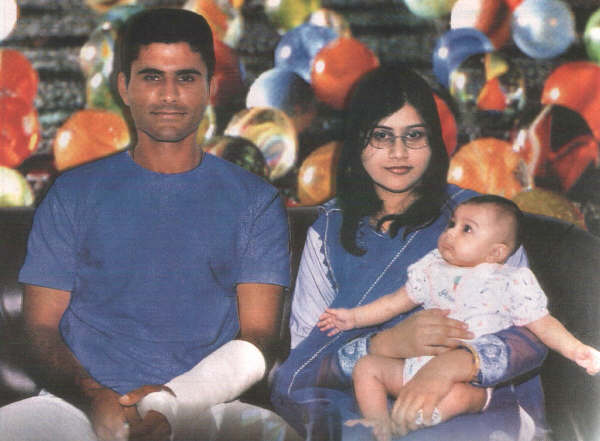
Afridi is from the Afridi tribe of the Khyber Agency in the Federally Administered Tribal Areas and hails from a Pashtun family.[2] He is married and has two daughters, Aqsa and Ansha.[5]
International career
In October 1996 at the age of sixteen Afridi was drafted into the ODI team during the four-nation Sameer Cup 1996–97 as a leg spinner as a replacement for the injured Mushtaq Ahmed.[6] He made his debut on 2 October against Kenya, however he didn't bat and went wicketless.[7] In the next match against Sri Lanka, Afridi batted at number three in the role of a pinch-hitter. In his first international innings, Afridi broke the record for fastest century in ODI cricket, reaching his hundred from 37 balls. The eleven sixes he struck also equalled the record for most in an ODI innings.[8][nb 1] Aged 16 years and 217 days, Afridi became the youngest player to score an ODI century.[10] Pakistan posted a total of 371, at the time the second-highest in ODIs, and won by 82 runs; Afridi was named man of the match.[8]
Two years after appearing on the international scene, Afridi made his Test debut in the third game of a three-match series against Australia on 22 October 1998.[11] By this point he had already played 66 ODIs, at the time a record before playing Tests.[12] He opened the batting, making scores of 10 and 6, and took five wickets in the first innings.[11] He played his second Test the following January during Pakistan's tour of India; it was the first Test between the two countries since 1990.[13] Again opening the batting, Afridi scored his maiden Test century, scoring 141 runs from 191 balls. In the same match he also claimed three wickets for 54 runs.[14] After winning the first match by 12 runs, Pakistan lost the second to draw the series.[15]
In 2001, Afridi signed a contract to represent Leicestershire. In five first-class matches he scored 295 runs at an average of 42.14, including a highest score of 164,[16] and took 11 wickets at an average of 46.45;[17] Afridi also played 11 one day matches for the club, scoring 481 runs at an average of 40.08[18] and taking 18 wickets at 24.04.[19] His highest score of 95 came from 58 balls in a semi-final of the C&G Trophy to help Leicestershire beat Lancashire by seven wickets.[20] Derbyshire County Cricket Club signed Afridi to play for them in the first two months of the 2003 English cricket season.[21] In June 2004 Afridi signed with English county side Kent to play for them in three Twenty20 matches and one Totesport League match.[22]
An innings-by-innings breakdown of Afridi's Test match batting career up to 30 December 2007, showing runs scored (red bars) and the average of the last ten innings (blue line).
Afridi made his presence felt in the third Test against India in March 2005, scoring a quick-fire second-innings half-century and taking five wickets in the match (including Tendulkar twice) to help Pakistan to win the game and register a series draw.[23] In April Afridi struck what at the time was the equal second-fastest century in ODIs; he reached 100 off 45 deliveries against India, sharing the record with West Indian Brian Lara.[24] Afridi was more consistent with his batting and bowling throughout 2005, starting with the tours of India and West Indies and through to the England tour. The Pakistani coach Bob Woolmer helped Afridi to reach a fuller potential by improving his shot selection and giving him free rein over his batting attitude.
On 21 November 2005, Shahid Afridi was banned for a Test match and two ODIs for deliberately damaging the pitch in the second match of the three-Test series against England. TV cameras pictured him scraping his boots on the pitch scuffing the surface when play was held up after a gas canister exploded. Afridi later pleaded guilty to a level three breach of the ICC code of conduct relating to the spirit of the game. Inquiries were made and Afridi's antics came into view. He was investigated and banned after the day's play, along with receiving a huge amount of criticism from the cricketing world for bringing the game into disrepute. Match referee Roshan Mahanama said: "This ban should serve as a message to players that this type of behaviour is not allowed." On this Afridi accepted his fault and said that a "senior player like me should set good examples to others because they see us to learn." His behaviour was also condemned by the Pakistan Cricket Board.[25][26][27]
On 12 April 2006, Afridi announced a temporary retirement from Test cricket so that he could concentrate on ODIs, with a particular focus on the 2007 World Cup, and to spend more time with his family. He said he would consider reversing his decision after the World Cup. Afridi had played ten Tests since being recalled to the side in January 2005, averaging 47.44 with the bat including four centuries.[28] However, on 27 April he reversed his decision, saying that "[Woolmer] told me that I am one of the main players in the team and squad and that Pakistan really needed me".[29] Before Pakistan toured England in July to September, Afridi played for Ireland as an overseas player in the C&G Trophy.[29] In six matches, he scored 128 runs[30] and took seven wickets.[31] England won the four-match Test series 3–0;[32] Afridi played two matches, scoring 49 runs[33] and took three wickets.[34] It was the last Test cricket Afridi played until 2010.[35]
Afridi was charged on 8 February 2007 of bringing the game into disrepute after he was seen on camera thrusting his bat at a spectator who swore at him on his way up the steps after being dismissed. Afridi was given a four-game ODI suspension, the minimum possible ban for such an offence, meaning that he would miss Pakistan's first two 2007 World Cup matches. The PCB and Afridi chose not to appeal the ban, despite feeling that the punishment was excessively harsh.[36]
In the 2007 World Twenty20, he performed poorly with the bat but brilliantly with the ball, earning the Man of the Series award, though he failed to take a wicket in the final and was out for a golden duck.But in the next ICC Twenty20 World Cup, held in 2009 Afridi performed brilliantly in the series scoring 50 runs in the semi-final and 54 in the final and leading his team to victory.
Ascending to the captaincy (2009–2011)
Afridi with his team mates in June 2009
Shortly after Pakistan won the 2009 ICC World Twenty20 the captain Younis Khan announced his retirement from Twenty20 cricket the Pakistan Cricket Board subsequently announced that Shahid Afridi had taken over the Twenty20 captaincy; the appointment was initially for one match, with a decision on the permanent replacement to be made later.[37] On 31 January 2010, Afridi was caught on camera biting into the ball towards the end of the 5th Commonwealth Bank ODI series in Australia.[38] Later Afridi pleaded guilty to ball tampering and he was banned from two Twenty20 internationals.[39]
In March 2010 the board announced that Shahid Afridi had been appointed ODI captain in place of the sacked Mohammad Yousuf he led Pakistan in the 2010 Asia Cup and during his first three matches as ODI captain he scored two centuries against Sri Lanka and Bangladesh he finished as the tournaments highest runscorer with 384 runs from 3 matches.
On 25 May 2010, Afridi was appointed captain of the national team in all three formats, after he announced his return to Test cricket.[40] In July 2010, Afridi captained Pakistan in the first Test of the series at Lord's against England. He scored 31 off 15 deliveries in the first innings and 2 in the second but was dismissed succumbing to rash strokes in both the innings. After the match, he announced retirement from Test cricket again citing lack of temperament for Test cricket as the reason.[41] Afridi was officially removed from the Test squad on the England tour, but after the spot-fixing scandal saw Mohammad Asif, Mohammad Amir and Test captain Salman Butt temporarily suspended by the International Cricket Council, he stated that he might return to Test cricket if "the team needs it".[42] According a representative of Afridi, he had voiced his concerns about Mazhar Majeed – who had approached Pakistan's players – in June.[43] Majeed also confirmed that he approached Afridi, Abdul Razzaq, Younis Khan and Saeed Ajmal but all off them refused to be affiliated with him of his fixing menace. Worth mentioning is that the four names given above were not associated in the original scandal and that no disciplinary action have been taken against them by the sports governing body the International Cricket Council.[44]
In October, Afridi stated in an interview with Express News that the squad had been selected without his consultation; the PCB gave him an official warning for the interview.[45] Coach Waqar Younis also expressed his unhappiness at having no input in selection, however Mohsin Khan, the chief selector, defended the decision, stating "it is not written down in the PCB constitution that the coach and captain(s) must have a say in the selection of any squad".[46] Pakistan lost the series 3-2.
The team toured New Zealand between December 2010 and February 2011 for two Tests, six ODIs, and three T20Is. Afridi stated just before the series that he had been working on honing his batting technique and that to address Pakistan's opening troubles he would open in Twenty20 Internationals in the future[47] During the T20Is, he became the first cricketer to reach 50 international wickets in the format when he had Nathan McCullum trapped leg-before.
When Pakistan's squad for the 2011 World Cup was announced, no captain was named; Afridi, the incumbent ODI captain and Misbah-ul-Haq, the Test captain, were the front runners for the position.[48] Pakistan lost the first match against New Zealand by 8-wickets, the second match got rained out and in the third Mohammad Hafeez scored a century and Afridi scored a blistering 65 from just 25 balls. The following match was a tight game but Pakistan prevailed by two-wickets thanks to three boundaries from Sohail Tanvir, the match was setup by a 93 not out from Misbah-ul-Haq. The fifth ODI was won for Pakistan by 43 runs courtesy of a maiden ODI-century from Ahmed Shehzad. Afridi helped in the lower order by scoring 24 and taking two crucial top order wickets to help guide Pakistan to a 43-run victory and their first ODI series win in two years.[49]
After gaining victory as a captain against New Zealand, the PCB declared Shahid Afridi as Pakistan's captain for the 2011 World Cup. In Pakistan's opening match of the tournament, Afridi took 5 wickets for 16 runs against Kenya, giving him the best bowling figures by a Pakistan bowler in a World Cup.[50] In the following match against Sri Lanka, which Pakistan won, Afridi claimed for more wickets to help his side to victory and became the second player to have scored 4,000 runs and taken 300 wickets in ODIs.[51][nb 2] He claimed 17 wickets from 6 matches in the first round of the Cup, including a five-wicket haul against Canada,[52] as Pakistan finished top of their group and progressed to the next stage.[53] Pakistan beat West Indies in the quarter-final by ten wickets, with Afridi taking four wickets.[54] Pakistan were knocked out of the semi-finals in a 29-run defeat to India.[55] Afridi was the tournament's joint-leading wicket-taker with 21 wickets, level with India's Zaheer Khan, even though Afridi had played one match less than him.[56]
Playing style
Afridi bowling his stock leg-spin delivery
Batting
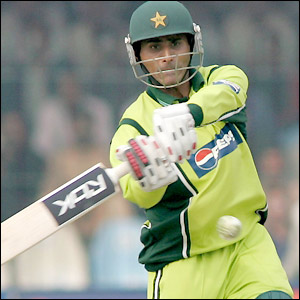
His general style of batting is very aggressive and attack oriented and has earned him the nickname "Boom Boom Afridi". Moreover, out of the seven fastest ODI centuries of all time, Afridi has produced three of them.[57] As of 19 April 2011, he has an ODI strike rate of 113.88 runs per 100 balls, the fourth highest in the game's history.[58] This attitude has been transferred to Test cricket as well, with Afridi scoring at a relatively high strike rate of 86.97. He has an approach to batting that can change the tempo of a game and inspire the mood of an audience, as shown when a mass exodus of spectators occurred in Pakistan in late 2005 following his dismissal from the crease.
He hits many sixes long and high, favouring straight down the ground or over midwicket and hit the longest ever six in the history of ODIs against Australia. His trademark shot is a cross-batted flick to the leg-side to a ball outside off stump.[59] However, his aggressive style increases his risk of getting out and he is one of the most inconsistent batsmen in cricket. This is reflected by the fact that he is the only player to score more than 6,000 ODI runs at an average under 25.[60] Afridi has moved about the batting order, and this lack of consistency has made it difficult for him to settle. In the Indian subcontinent, where the ball quickly loses its shine, he prefers to open the batting however elsewhere he prefers to bat at number six.[61]
Bowling
Having started as a fast bowler, Afridi decided to start bowling spin after someone told him he was throwing. He modelled himself on Pakistan leg-spinner Abdul Qadir.[2] Afridi began his career as primarily a bowler, however after scoring the fastest century in his maiden ODI innings more was expected of him with the bat. He considers himself a better bowler than batsman.[61] While he is renowned for his aggressive batting, he is also a handy leg-spinner capable of producing a good mix of wicket taking balls.[62] He has over 300 International wickets, most of which are from the ODI format. While his stock ball is the leg break, his armoury also includes the conventional off break and a 'quicker one' which he can deliver in the style of a medium-pacer, reaching speeds of around 130 kilometres per hour (80 mph).[63] He bowls at a high speed for a spinner, resulting in lesser turn, and relying more on variations in speed. He occasionally sends down a bouncer to a batsman, which is very rare for a spin bowler.
Shahid Afridi
Shahid Afridi
Shahid Afridi
Shahid Afridi
Shahid Afridi
Shahid Afridi
Shahid Afridi
Shahid Afridi
Shahid Afridi
Kenya vs Pakistan, Shahid Afridi 5 wickets, 2011 World Cup Highlights